Foods and plants that are toxic to dogs and cats
These are the foods and plants that Norwegian and foreign sources list as dangerous for dogs, cats or both, with the source for each entry.
10 October 2026 · 6 min read
Made by: Dyrli editorial desk. We show what we checked and when.
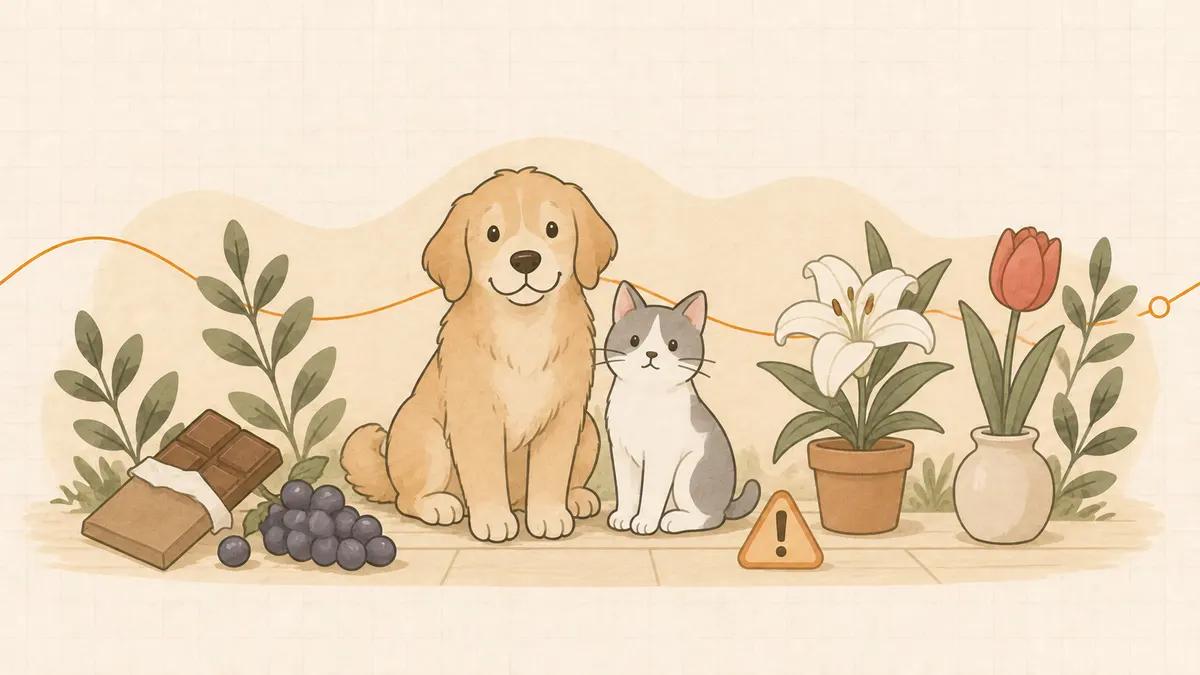
Chocolate, xylitol, grapes and raisins, onions and lilies are among the foods and plants that the sources list as dangerous for dogs, cats or both. Below is the full list, which animal each entry applies to, and where the information comes from. If you think your pet has eaten or chewed something on the list, contact a veterinarian or an emergency veterinary service.
Short answer
- The list is based on Norwegian sources such as the Norwegian Poison Information Centre, the Norwegian Veterinary Institute and Dyrebeskyttelsen Norge. Many entries come from the American animal welfare organisation ASPCA, which is a foreign source.
- Some entries apply to dogs, some to cats, and many to both. Where only one animal is named, the source says nothing about the other.
- True lilies and daylilies are highly toxic to cats, according to the Norwegian Poison Information Centre.
- The list is not complete. If something is missing here, that says nothing about how dangerous it is.
Food
The links in the first column go to the pet hazard register, where you can see the source for each animal. Entries without a link have no page for dogs or cats in the register.
| Food | Applies to | Source |
|---|---|---|
| Chocolate and cocoa | Dogs and cats | Giftinformasjonen (dogs, in Norwegian), ASPCA (cats) |
| Xylitol, a sweetener found in chewing gum and other products | Dogs | Giftinformasjonen (in Norwegian) |
| Grapes and raisins | Dogs | Giftinformasjonen (in Norwegian) |
| Macadamia nuts | Dogs | Giftinformasjonen (in Norwegian) |
| Onion, garlic, leek and chives | Dogs and cats | ASPCA, ASPCA on leek |
| Alcohol | Dogs and cats | ASPCA |
| Coffee and other caffeine | Dogs and cats | ASPCA |
| Raw yeast dough | Dogs and cats | ASPCA |
| Very salty food and salt-dough ornaments | Dogs and cats | ASPCA, ASPCA on the holidays |
| Stone fruit such as cherry, plum and peach: the stone, leaves and stem | Dogs and cats | ASPCA on cherry, plum and peach |
| Apple: the seeds, leaves and stem | Dogs and cats | ASPCA |
| Tomato plant | Dogs and cats | ASPCA |
| Rhubarb | Dogs and cats | ASPCA |
Plants
Lilies come first because they apply to cats only. The rest are in alphabetical order.
| Plant | Applies to | Source |
|---|---|---|
| Lilies and daylilies | Cats | Giftinformasjonen (in Norwegian) |
| Autumn crocus | Dogs and cats | ASPCA |
| Azalea and rhododendron | Dogs and cats | ASPCA |
| Christmas rose | Dogs and cats | ASPCA |
| Daffodils (Norwegian påskelilje and pinselilje) | Dogs and cats | ASPCA |
| Dieffenbachia | Dogs and cats | ASPCA |
| Foxglove | Dogs and cats | ASPCA, Dyrebeskyttelsen Norge (in Norwegian) |
| Hyacinth | Dogs and cats | ASPCA |
| Ivy | Dogs and cats | ASPCA |
| Kalanchoe | Dogs and cats | ASPCA |
| Laburnum | Dogs and cats | Norwegian Veterinary Institute, Dyrebeskyttelsen Norge (both in Norwegian) |
| Lily of the valley | Dogs and cats | ASPCA |
| Monstera (Swiss cheese plant) | Dogs and cats | ASPCA |
| Peace lily | Dogs and cats | ASPCA |
| Tulip | Dogs and cats | ASPCA |
| Yew | Dogs and cats | ASPCA |
Lilies are highly toxic to cats
The Norwegian Poison Information Centre writes that true lilies and daylilies are highly toxic to cats. If you think your cat has tasted a lily, contact a veterinarian or an emergency veterinary service.
The Norwegian plant names can be confusing. Påskelilje and pinselilje have "lily" in their names, but they are daffodils, not true lilies, according to the Norwegian Poison Information Centre. ASPCA still lists daffodils as toxic to both dogs and cats. In English it is the other way round: the Easter lily is a true lily, and ASPCA lists it as toxic to cats.
Christmas and Easter
A British study from 2017 looked through records from veterinary practices. Dogs that had eaten chocolate were recorded more often around Christmas and Easter than at other times of the year. We found no Norwegian official source that says the same.
Christmas. ASPCA warns about lilies in holiday bouquets, because many of them are highly toxic to cats. Salt-dough ornaments can also tempt pets, even when they are dry, ASPCA writes.
Easter. Daffodils are on the list for both dogs and cats, according to ASPCA. The Norwegian Poison Information Centre distinguishes them from true lilies, which are highly toxic to cats.
If your pet has eaten something
Contact a veterinarian or an emergency veterinary service. That is the only advice we offer, because we cannot assess what applies to your pet.
- The Norwegian Poison Information Centre does not answer questions about animals. Call your vet instead.
- Outside normal working hours, the municipality is responsible for organising an emergency veterinary service, under section 3 a of the Veterinary Act (in Norwegian). Check your municipality's website for the service where you live.
- There is not always a service. Bergen municipality says that from 9 October to 19 December 2026 there will be long periods with no municipal emergency service for small animals, and that there is no emergency service at night.
Find the numbers for your vet and for the emergency veterinary service where you live before you need them.
About the list
- We have included what the sources list as dangerous for dogs, cats or both. Where the sources disagree, we have left the entry out.
- If something is missing, that says nothing about how dangerous it is.
- Search the pet hazard register for more foods, plants and substances. There you can see the source for each animal.
If you have a new puppy or kitten, there is more about the first months in the guides to your puppy's first year and your kitten's first year.
Frequently asked questions
Which foods are dangerous for dogs?
Our sources mention chocolate, xylitol, grapes and raisins, macadamia nuts and onions, among others. See the full list above.
Which plants are toxic to cats?
True lilies and daylilies are highly toxic to cats, according to the Norwegian Poison Information Centre. The list above also has many plants that apply to both dogs and cats.
Can I call the Norwegian Poison Information Centre about my pet?
No. It does not answer questions about animals. Contact a veterinarian or an emergency veterinary service.
Is the Norwegian påskelilje a lily?
Not a true lily, according to the Norwegian Poison Information Centre. It is a daffodil, and it is still on the list for both dogs and cats.
Why is a plant I know missing?
The list is not complete, and we have left out entries where the sources disagree. If something is missing, that says nothing about how dangerous it is. Ask your vet.
Is there always an emergency veterinary service?
The municipality must organise an emergency veterinary service outside normal working hours, but there may not always be a service for small animals. Check your municipality's website.
What we checked
Sources were checked on 9 October 2026.
- Norwegian Poison Information Centre (Helsenorge): Dogs and cats (in Norwegian)
- Norwegian Poison Information Centre (Helsenorge): Chocolate and dogs (in Norwegian)
- Norwegian Poison Information Centre (Helsenorge): Xylitol and dogs (in Norwegian)
- Norwegian Poison Information Centre (Helsenorge): Raisins, grapes and dogs (in Norwegian)
- Norwegian Poison Information Centre (Helsenorge): Macadamia nuts and dogs (in Norwegian)
- Norwegian Poison Information Centre (Helsenorge): Lilies and cats (in Norwegian)
- Norwegian Veterinary Institute: More farm animals poisoned by plants than usual (26.10.2018, in Norwegian)
- Dyrebeskyttelsen Norge: Animal-friendly gardening (15.06.2023, in Norwegian)
- Lovdata: Veterinary Act, section 3 a on the municipality's duty to organise an emergency service (in Norwegian)
- Bergen municipality: Emergency veterinary service in Bergen (in Norwegian)
- ASPCA (USA): People foods to avoid feeding your pets
- ASPCA (USA): Holiday hazards for pets
- ASPCA (USA): Plant list for dogs
- ASPCA (USA): Plant list for cats
- ASPCA (USA): Easter lily
- Noble et al. (2017), Veterinary Record (UK): Canine chocolate exposure at Christmas and Easter
These guides provide general information. They do not replace advice from a veterinarian or an insurance company. We flag anything that needs a closer check.
Related guides
More guides on the same or a similar topic.